
Kingsville Previous Residents by Era
One Kingsville address can have a longer land trail than its street number suggests. The county’s online deed sources split at 1987, while the verified directory years are snapshots rather than a continuous list. A building map or cemetery entry can add context, but it does not identify everyone who lived at the address. Start with the source closest to the date in question, record its date and type, then compare independent evidence before making a historical statement.
| Source | Years it covers | Where held | What it can show |
|---|---|---|---|
| Kofile deed and oil/gas index | 1845–1987 | Kleberg County Clerk historic portal | Parties, instrument path, and recorded legal interest |
| Current county land records | September 1987–present | Kleberg County Clerk public search and counter | Modern recorded instruments and related county indexes |
| Kingsville directories | 1954–55, 1974, 1984 | TSLAC reading room; local library reference shelf | Dated printed name, address, phone, and household detail when shown |
| Kingsville Record pages | 1930s–later pages visible | UNT Portal to Texas History | Notices, obituaries, classifieds, and community leads |
| Sanborn and cemetery material | 1915 / 1962; 1904–present burial span | Official map list and THC Atlas | Building context or burial evidence, not a residence claim alone |
The County Clerk counter, public terminal, phone, mail, and a focused Texas Public Information Act request are documented alternatives when an online index is incomplete. For older local context, the Robert J. Kleberg Public Library and South Texas Archives are separate access channels, not merely web links.
Start Kingsville Past Residents With a Parcel
Begin with the present address in the Kleberg County Appraisal District search. Enter the street number and simple street name, without a prefix, suffix, or unit number. Save the property ID, geographic ID, subdivision, and legal description that connect the physical address to a parcel. CAD’s owner field is an appraisal lead. It is not a substitute for the current title record, and it does not establish a household at the address.
The exact parcel matters when the printed address is a corner address, a named complex, or a lot with several structures. If a number does not return cleanly, CAD also exposes subdivision, condo, mobile-home park, neighborhood, and advanced paths. The CAD interactive map can help orient a parcel, but the direct map interface did not yield a captured adjacent-parcel result. Keep any map observation separate from the legal description and recorded instrument.
Cross Kingsville’s 1987 Deed Split
The backward chain begins with the current land-record system, which the County Clerk identifies as covering real-property records from September 1987 forward. Locate the most recent deed into the current owner by party name and legal description. Record the grantor, grantee, recording date, instrument placement, legal description, and mailing address. Then use the prior grantor as the next person to search. The address itself may be absent from older recorded instruments.
- Use CAD to save the current parcel identifiers and its legal description.
- Search current Kleberg land records for the most recent recorded transfer into the owner shown by CAD.
- Write down each party role and any book, volume, page, or document reference visible in the record.
- Follow the prior grantor backward, using the exact legal description as a second check.
- At the 1987 boundary, switch to the historic Kofile index, which covers 1845–1987.
- Grantor and grantee
- The grantor transfers an interest; the grantee receives that recorded interest.
- Chain of title
- A sequence of recorded transfers tied together by parties and the legal parcel description.
- Legal description
- The recorded land description, such as an abstract, subdivision, lot, or block, that can persist when a street form changes.
Index access and image access are different. Kofile offers Type, Year, Parties, Last Name, and First Name search controls, plus a Book, Volume, and Page mode. Purchased image access requires an account, so an index result should first be treated as a location key.
Kingsville Address Meanings Matter
Several address-like fields can appear on the same research trail. A situs address is the physical location used by CAD, USPS, GIS, permits, or code files. A legal description identifies the property in the recorded instrument. A grantee mailing address is where notice or a record copy may have been sent, and it can be outside Kingsville. A directory address is a dated printed listing that may have a telephone or business use.
Keep those fields in separate columns. Deeds recorded after December 31, 1981 must contain each grantee’s mailing address, but that rule does not make the mailing line the parcel location. For title history, the legal description is usually the stronger bridge. For a household history, compare the directory year, newspaper date, and any other dated source rather than turning a mailing line into a residence claim.
Kingsville Previous Residents in Directories
The verified Kingsville directory holdings at the Texas State Library and Archives Commission are 1954–55, 1974, and 1984. A Polk’s Kingsville directory from 1963 is a catalog lead, not confirmed online content. Start with the nearest verified year, search the surname, then read the street sequence and nearby entries. Extract the name as printed, street address, phone, spouse or household notation, and any other field actually present. An omission does not prove a vacancy.
- Preserve the modern and historical street forms before looking for a directory listing.
- Compare the nearest directory year with the next verified year instead of filling the interval with an assumption.
- When a census schedule is relevant to family history, place its enumeration date beside the directory publication year rather than treating the two as one date.
- Use the Kingsville Record for notices or obituary leads between directory snapshots.
- Compare a listing date with the deed recording date and the legal-description trail.
- Ask the library or archives about local microfilm, vertical files, and unlisted material when the web shelf list ends.
The verified years, shelf access, and entry-reading details are collected with the Kingsville city directories. Use that historical shelf as a dated household layer, then return to the deed trail for recorded property interests.
The Jennie L. Splawn Genealogy Room is the local-history lead represented in this image. The library’s resources point researchers to genealogy material, newspaper routes, and Texas land-grant tools.
Ask about reverse directories, obituary indexes, and back issues rather than assuming every run appears in the web catalog.
Map Kingsville Previous Residents Carefully
Maps and permit files can date the structure or clarify its setting, but they do not replace a household source. The official TXDOT Sanborn list identifies Kingsville editions for 1915 and 1962. City planning publishes current streets, historic-district, Downtown National Register, zoning, and city limits–ETJ maps. Compare a historical footprint and street geometry before saying that a current structure is the same building shown on an old map.
For a permit or inspection lead, request city records with an exact address, record type, and date range through the Kingsville open-record request channel. Planning says a current residential review is 10 business days. That is a current processing estimate, not a date range for historical permit files. A remodel, replacement, addition, or inspection is an event on a property, not proof of who lived there.
Kingsville House Clues at Archives
South Texas Archives at Texas A&M University–Kingsville offers a route for details that do not fit a standard index. Its more than 400 collections include personal and family, railroad, ranching, oil and gas, newspaper, oral-history, photo, church, government, and community material. Research hours are Monday through Friday, 8 to 12 and 1 to 5, with an appointment advised. Ask for a finding aid, then request a specific box or item rather than relying on a broad search-result label.
The John Salisbury House Family Collection includes a caption for a 1915 Gaskill house in the 300 block of W Lee. That is a strong test case for house history: compare the caption with a Sanborn footprint, historic street form, legal description, deed chain, and dated directory or newspaper evidence. It is not a shortcut to identifying every household connected with the address.
South Texas Archives finding aids are shown in this Kingsville previous residents image. The repository is a practical substitute when a separate county historical-society index has not been verified.
Use the archive’s subject and geographic terms to locate material, then preserve the collection and item reference with each historical note.
Kingsville Past Residents in Print
The digitized Kingsville Record provides a dated newspaper route between formal directory years. Search notices, classified material, obituaries, and community items as leads. TAMUK material identifies the Gulf Coast Record to Kingsville Record to Kingsville Publishing Co. lineage, so historical searches may need title variations. A newspaper item should be checked against the county land record or a dated directory before it becomes an address conclusion.
The newspaper image illustrates a source type that can connect a name, date, and place without functioning as a complete resident list.
Chamberlain Cemetery’s Texas Historical Commission Atlas record documents cemetery ID KL-C005, 10,810 graves, and a 1904–present burial span. Cemetery evidence can help confirm a death or family connection, but it does not establish residence at the time of death.
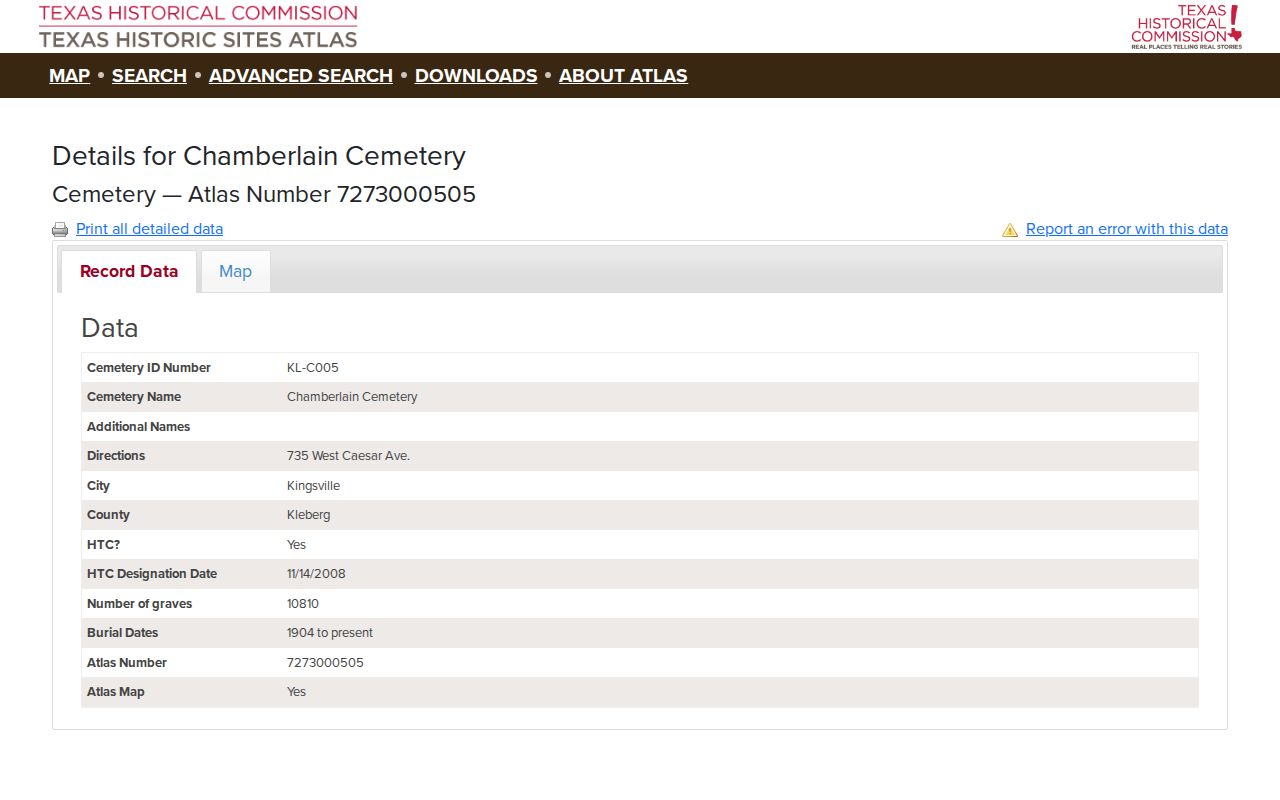
Pair a burial record with an obituary, directory, deed, or archive item before assigning a person to a former address.
Kingsville Past Residents: Deed Limits
A careful historical trail labels each source for what it can establish. A deed records an interest transfer. CAD supplies appraisal context. A city directory prints a household listing at publication time. A newspaper preserves a public mention. Maps place a structure or street form. Only agreement among dated sources supports a cautious statement about who lived at an address in a particular period.
Lawful use. Kingsville house-history research is for personal, family, estate, and local-history purposes. Never use a historical address trail to stalk, harass, track, or harm a living person.
When the online trail stops, use the County Clerk counter or public terminal, phone 361-595-8548, mail procedures, a specific Chapter 552 request, the library, or TAMUK Archives. Keep the original printed address if no authoritative crosswalk resolves it. No verified citywide renumbering crosswalk was located.