
Kingsville City Directory Holdings
Verified Kingsville city directory holdings are concentrated in the Texas State Library and Archives Commission, while Robert J. Kleberg Public Library confirms a current Kingsville City Directory subscription and back issues in its Texas Reference Collection. The online library material does not expose a complete local shelf list, so it is important not to fill in missing years. The State Library list gives the firm dates that can be cited. Its print and microform materials are consulted in the Austin Reading Room, and staff do not perform telephone searches, transcriptions, or email scans.
| Collection or lead | Years | Where held | Access |
|---|---|---|---|
| Kingsville city directories | 1954–55 | Texas State Library and Archives Commission | Austin Reading Room |
| Kingsville city directory | 1974 | Texas State Library and Archives Commission | Austin Reading Room |
| Kingsville city directory | 1984 | Texas State Library and Archives Commission | Austin Reading Room |
| Polk’s Kingsville catalog lead | 1963 | Genealogy-library catalog | Verify the item before relying on it |
| Kingsville Record pages | 1930s and later pages visible | UNT Portal to Texas History | Digitized newspaper search |
These collections answer different questions. A printed directory can show a published name-and-address association. The newspaper can supply a dated notice or classified lead. Neither replaces a deed, which records an interest in land rather than a household listing.
Kingsville City Directory Years at TSLAC
The Texas State Library holdings list verifies 1954–55, 1974, and 1984 Kingsville volumes. It does not identify a publisher in the rendered Kingsville entries. That uncertainty belongs in research notes rather than in a guessed citation. The 1954 and 1955 volumes are especially helpful as adjacent snapshots: compare the spelling, address, telephone number, spouse notation, and any occupation line that actually appears in the volume.
The State Library’s broader city-directory guide explains that entries commonly contain a name, street address, telephone number, and spouse, with occupation or owned/rented information only in some editions. It also identifies other search routes, including library databases, WorldCat, the Library of Congress, and Texas collections. A catalog record is a lead. It is not evidence that a particular page or household entry exists.
For a view of the verified holding list, consult the Texas State Library source before visiting or contacting its reference staff.
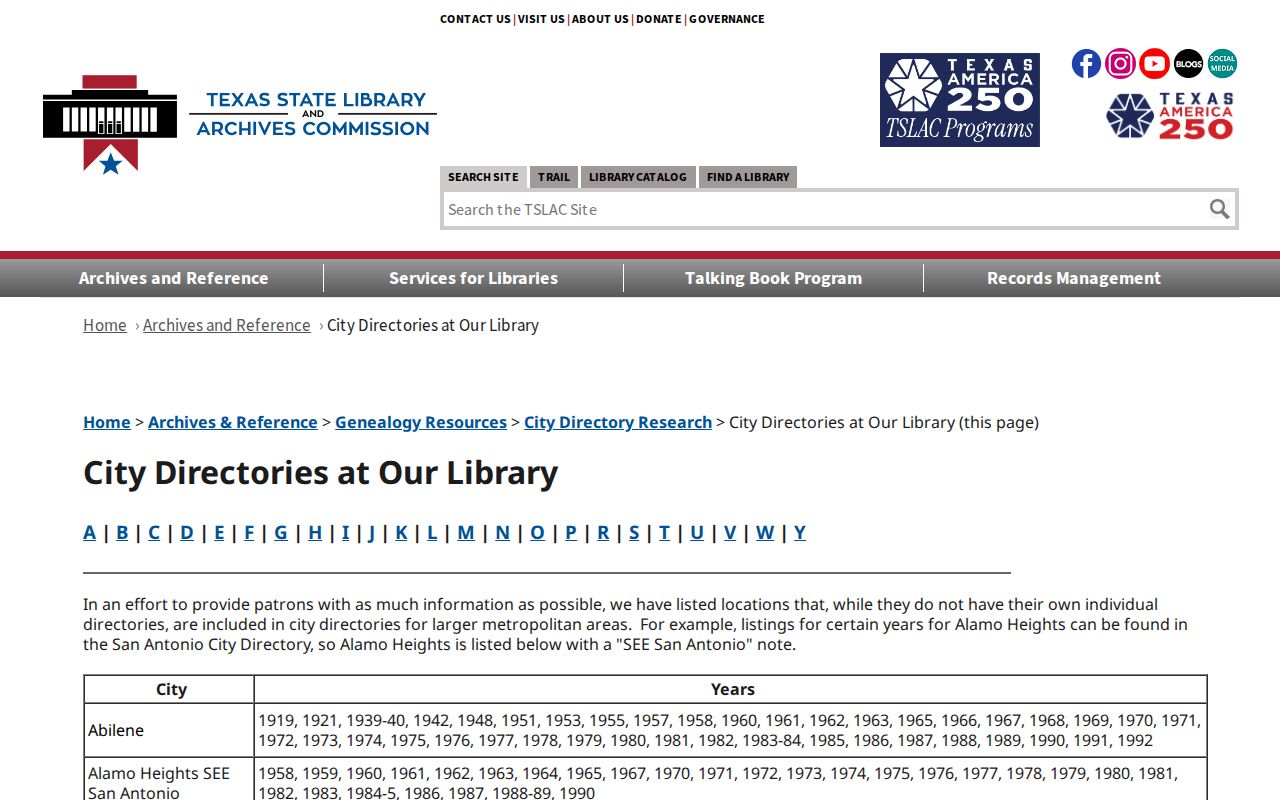
The holdings view supports the limited year set above and is a useful check against an unsourced claim of continuous local directory coverage.
Note: The available list verifies individual years, not a complete first-to-last publishing run for Kingsville.
Kingsville City Directory Shelf at the Library
Robert J. Kleberg Public Library, at 220 N 4th Street, is the local first stop for a physical Kingsville city directory question. Its published hours are Monday through Friday, 8 a.m. to 5 p.m., plus the first Saturday of each month, 8 a.m. to 5 p.m. The library lists its genealogy and Texas land-grants resources, including links to the Jennie L. Splawn Genealogy Room, local newspapers, and several historical research services. Call 361-592-6381 before a special trip and ask whether the desired year, a reverse directory, microfilm, or vertical file is available.
The library’s reference-services policy is the clearest local statement: it says only the Kingsville City Directory is currently subscribed to and that back issues are shelved with the Texas Reference Collection. It also describes South Texas materials, selected microfilmed newspapers, and American and Hispanic genealogy resources. Ask staff for unlisted material rather than converting the shelf description into a date range.
See the local library’s genealogy and local-history entry point for the research links available from its catalog and reference pages.
The library image is a starting point for asking about materials that have not been itemized online.
The local directory policy page also documents the Texas Reference Collection placement.
That policy is why a request for a specific volume should include the year and whether a name or an address is the starting point.
Kingsville Directory Leads in Regional Print
The UT Briscoe Center directory index includes a January 1911 City Directory of Corpus Christi, Texas from the Southwestern Directory Company. Its indexed locations include Kingsville, but it is a regional lead, not a verified Kingsville-only volume. Search the location scan or contact the repository before treating it as a complete household list for the city.
For the long gaps between confirmed directory years, the digitized Kingsville Record search can surface obituaries, marriage notices, club reports, property-sale notices, and classified pages. Those pages can point to a surname, address, or organization. They should then be checked against a dated directory, archive item, cemetery record, or county record as appropriate.
The Kingsville Record archive shows how historical newspapers can preserve directory-like material without being formal city directories.
A classified or notice can date a public appearance, but it should not be presented as a full residential directory entry.
Reading a Kingsville City Directory Entry
Read the complete entry before drawing a conclusion. The name may be printed surname first, may use initials, and may differ from a later record because of a maiden name, compound surname, or a spelling choice by the publisher. A street address and telephone line can belong to a household, a business, or a boarding arrangement. The volume’s own abbreviation key is the authority for its marks. Not every directory contains every field.
| Name as printed | Preserve initials, surname order, and spelling variants for later searches. |
|---|---|
| Address | Record the street, apartment or room if printed, without silently converting an old form to a modern one. |
| Household notation | Note a spouse or householder reference when the volume actually supplies one. |
| Telephone or business line | Use it as a dated contact or business lead, not proof of ownership or continued residence. |
| Occupation or ownership notation | Copy only an explicit printed field or symbol and consult the abbreviation key. |
- Criss-cross directory
- A street-order section that can place listed households or telephone entries beside an address sequence.
- Householder index
- An alphabetical arrangement focused on the person or household named by the directory.
- Abbreviation key
- The volume’s explanation of shortened labels and symbols; photograph or transcribe it with the entry.
A missing name can mean a move, an omission, a different spelling, a business-only listing, or an edition with limited coverage. It does not prove that the address was vacant.
Tracing Kingsville City Directory Households
A household trail works best when every line is dated. Start with the closest verified volume, preserve what it prints, and then test the next available directory year. Pair that sequence with census years, newspaper notices, maps, and land records only for the distinct point each source supports. This avoids turning a publication date into an unbroken claim of residence.
- Normalize the modern address with USPS and CAD instructions, while preserving an older printed street form in the notes.
- Search the closest confirmed Kingsville city directory year by surname and name variants, then inspect the relevant street sequence.
- Record the exact address, telephone, household notation, and occupation or business text that appears.
- Compare the next verified directory, then test a Kingsville Record notice or archive finding aid for the years between them.
- Use the Kleberg deed index, CAD parcel record, and legal description only to test a property transition, not to equate ownership with occupancy.
The familiar sequence is directory, newspaper or archive lead, deed or parcel check, then a cemetery or vital source where a dated life event is relevant. Each item answers a narrower question. The result is stronger when the dates line up and weaker when one source stands alone.
Kingsville Archives Beyond Directories
South Texas Archives at Texas A&M University–Kingsville supplies another route when a directory omits a household. It has more than 400 collections and publishes basic and advanced search tools plus subject browsing. Research hours are Monday through Friday, 8 a.m. to noon and 1 p.m. to 5 p.m.; an appointment is advised. The archive’s subjects include personal and family papers, ranching, railroad, oil and gas, military, newspaper, photo, oral-history, Hispanic, and university collections.
Finding aids identify leads such as Kleberg County Historical Commission records, the John Salisbury House Family Collection, church material, oral histories, and Jimmy Dodd photographs. Request the box or item after finding a catalog lead. A photograph caption or oral-history mention can give historical context, but it is not automatically an address record.
The South Texas Archives collections browser is the appropriate starting point for a subject, place, organization, or family search.
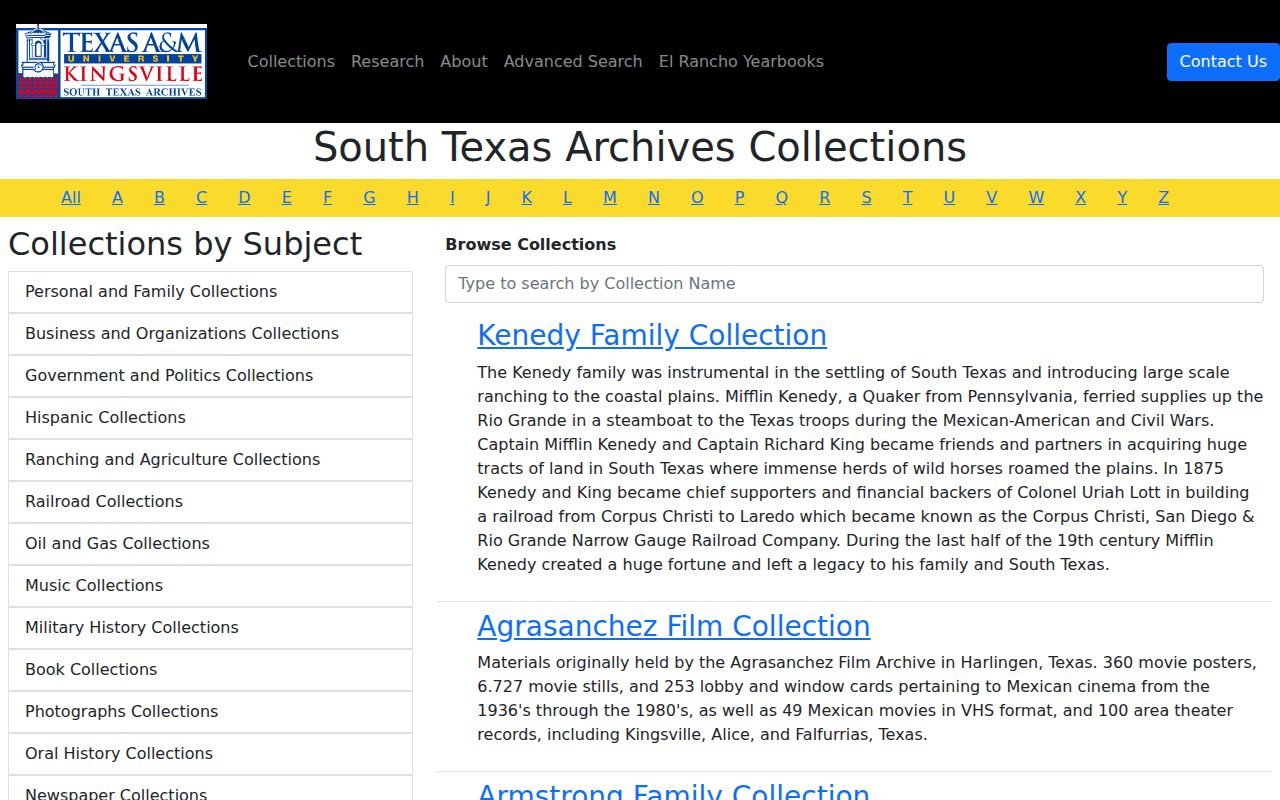
The collection categories can bridge a directory gap while keeping a catalog lead separate from a verified household listing.
Kingsville City Directory Addresses in Context
Printed addresses need local context. City historical material identifies Richard, Henrietta, Alice, and Lee as streets tied to the King family and friends, and it describes a historic business district along the 200–400 blocks of East Richard. Those details help a researcher recognize a place in an older volume. They do not create a complete demographic record for any block.
For a building question, compare the directory date with the officially listed 1915 and 1962 Sanborn map eras, current planning maps, and the parcel legal description. A change in street geometry, a business address, or a later rebuilding can break an apparent match. There is no verified countywide street-renumbering crosswalk in the research, so retain the printed address until authoritative map, planning, or deed evidence resolves it.
Note: A city directory documents a published listing for its own date, not continuous residence, ownership, or a modern mailing address.
Kingsville City Directory Gaps and Anchors
Research gaps are useful facts. No complete online shelf list for Kingsville printed or reverse directories was found, and no standalone obituary-index year range was verified. The documented alternatives are the local library counter, the Texas State Library reading room, the UNT newspaper archive, and South Texas Archives finding aids. Ask each custodian for a named year, surname variant, address, or collection title.
The Texas Historical Commission’s Chamberlain Cemetery Atlas record is another dated history anchor. It records Chamberlain Cemetery as KL-C005, with 10,810 graves and burial dates from 1904 to the present. Burial information can support a death or family-history lead, but it does not establish where a person lived at the time of death.